
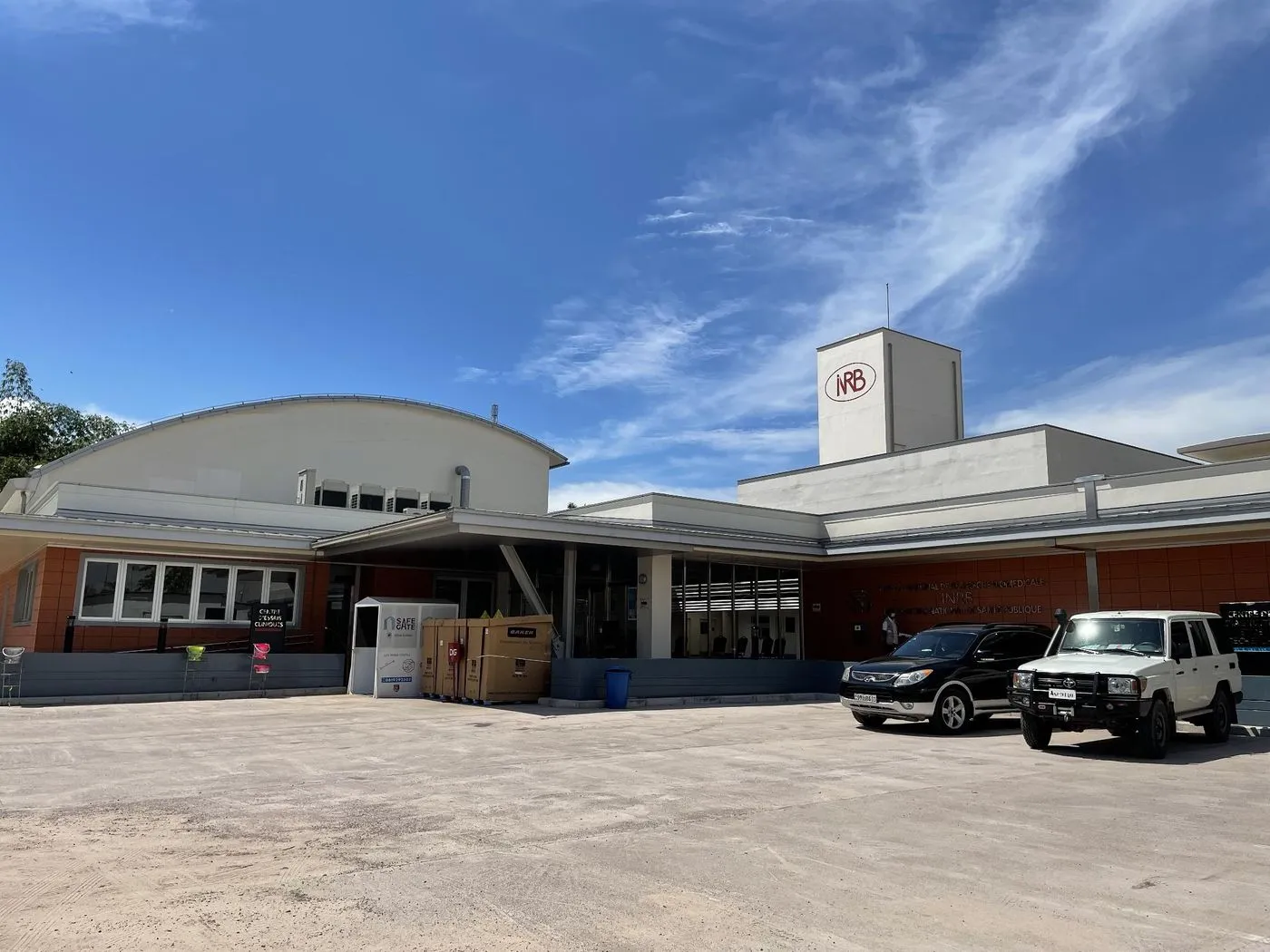
 Field photo · DR Congo
DR Congo
— From the field to the unknown, and on to real-world impact.
Building a research hub in DR Congo
コンゴ民主共和国における海外研究拠点形成
Overview
Overview
What is J-GRID+
J-GRID+ is an AMED research network program that establishes overseas research hubs in infectious-disease endemic regions across Asia, Africa and South America to advance basic research on emerging and re-emerging infections. Each hub accumulates knowledge on pathogens, hosts and epidemiology through joint research with local institutions, strengthening Japan’s capacity to respond to infectious diseases.
The hub’s theme
The DR Congo (DRC) hub is run in partnership between Osaka Metropolitan University and the national biomedical research institute INRB. Its guiding theme is captured in a single line.
Advancing the search for unknown pathogens through comprehensive pathogen and host immune-response analysis
What this page tells you
The DRC hub connects clinical practice, specimens, genomic analysis and immune analysis in the field into one system, aiming for early detection of undiagnosed infections and real-world implementation. Here we introduce its overall shape and progress.
At a glance
- Partner institution
- INRB
- Region
- DR Congo
- Field
- Emerging & re-emerging infections
- Since
- 2017 — ongoing
Program name and funding details will be added once approved by the public-relations office.
Why DR Congo
Why DR Congo
One of the frontlines most directly tied to early warning of global outbreaks.
DRC is a region where emerging and re-emerging infections occur frequently, and where a considerable number of suspected cases remain undiagnosed. Re-examining “cases that couldn’t be diagnosed” through science is a clue to catching the next infectious-disease risk early.
Why this hub matters
- Holds an important position as an international infectious-disease research hub
- Builds on human infection cohorts as its research foundation
- Integrates clinical, epidemiological and pathogen data gathered in the field
- Aims to connect findings to new diagnostics, treatments and vaccines
Infrastructure
Research infrastructure at the DRC hub
Connecting clinical practice through analysis to real-world implementation.
Human infection cohort
A research base integrating clinical information and specimens from suspected cases of malaria, mpox, COVID-19 and others.
Local analytical capacity
Leveraging next-generation sequencers and other advanced equipment, we aim to build analysis capacity for specimens that are difficult to transport abroad.
Data sharing & pathogen transfer
We maintain information sharing with the international community including Japan, cold-chain logistics, regulatory checks, and domestic storage/analysis including BSL3.
Focus areas
Research focus areas
Each theme will be introduced in more depth on future individual pages.
Malaria
Asymptomatic infection, severe disease, placental malaria, drug resistance — approaching the full picture of disease burden through mother-child cohorts.
Mpox
Clarifying transmission routes and clinical presentation, including sequelae, through cohort studies and genomic diversity analysis.
One Health
Surveying across wildlife, livestock and the environment to trace how infections pass to humans.
Omics analysis
Comprehensive analysis including metabolomics and transcriptomics to explore new biomarkers.
Undiagnosed-disease surveillance
Making visible infections that could not previously be captured, centered on metagenomic NGS and PhIP-Seq.
Social implementation
Returning research to the field through diagnostics, treatment and vaccine development, POC trials, and workforce development.
* Detail pages for each theme will be published as they become ready.
Core themes
Core themes of the DRC hub
We are growing two axes in parallel: the science of reading clues from specimens, and the implementation that delivers them to the field.
Undiagnosed-disease surveillance science
Turning cases that end in “negative” or “unknown” into data for the next discovery.
Cases clinically suspected of infection but undiagnosable by routine testing. Centered on such undiagnosed-disease cohorts, the DRC hub is advancing integrated surveillance combining metagenomic NGS, which comprehensively reads pathogen genomes, with PhIP-Seq, which reads host immune responses. Even cases where the pathogen itself cannot be found can be approached through the clue of immune response — that is the meaning of layering these two lenses.
Lens 1 · Metagenomic NGS
Broadly reads nucleic acids in a specimen to search for candidate pathogens.
Lens 2 · PhIP-Seq
Reads the antigens recognized by serum antibodies to estimate infection history.
This integrated surveillance leads toward discovering unidentified pathogens, building early-warning systems, and developing new diagnostics.
Coming soon A technical explainer on metagenomic NGS and PhIP-Seq will be introduced in detail on a dedicated page to be published.
Point-of-Care Testing (POCT) development
Developing fast, simple diagnostics usable outside the laboratory. We aim to translate findings from metagenomic NGS and PhIP-Seq into forms usable in the field.
Coming soon Details to follow.